Cool Rubber Duck Embroidery Design
First Stitch, First Impression: A Bright, Playful Character That Feels Instantly Familiar
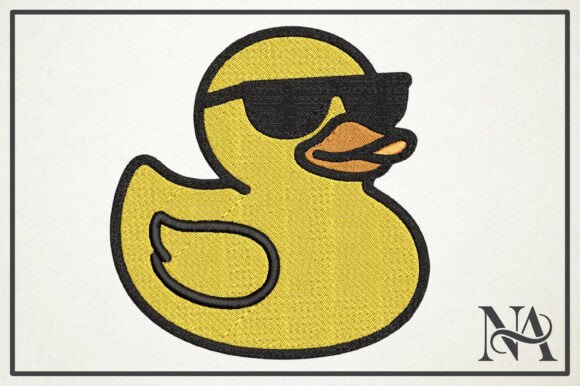
When I opened the Cool Rubber Duck Embroidery Design, what struck me wasn’t just the yellow—it was the attitude. This isn’t a generic duck silhouette; it’s a character with personality: bold sunglasses, a slightly tilted head, and that unmistakable rubber-duck buoyancy translated into clean, confident stitch lines. As a designer who’s stitched everything from nursery monograms to boutique aprons, I immediately saw its range—not as “cute for baby,” but as *playfully professional*. It lands somewhere between retro summer camp charm and modern minimalist illustration, making it unusually versatile for both handmade gifts and small shop merchandise.
Real Project Test: Embroidering It on a Linen-Cotton Tea Towel for a Local Kitchen Boutique
Last week, I used the Cool Rubber Duck Embroidery Design on a set of 12 tea towels—linen-cotton blend, medium weight, light cream ground. I chose a soft matte yellow thread for the duck body and glossy black for the sunglasses frames, pairing them with a lightweight cutaway stabilizer. The result? Crisp satin-stitched beak and sunglass lenses, smooth fill-stitched body, and just enough running-stitch detail in the wing curve to suggest movement without overcrowding. Customers loved how it looked *hand-finished*, not digital—proof that even a vibrant machine embroidery design can hold warmth when executed thoughtfully. It didn’t read as “clip art”; it read as intentional branding.
Where This Design Shines—and Where It Needs Thoughtful Placement
The Cool Rubber Duck Embroidery Design thrives on stable, medium-weight fabrics: cotton twill for tote bags, fleece-backed sweatshirts, structured aprons, and pillow covers with tight weaves. On a custom embroidered tote for a children’s bookstore? Perfect—its scale reads clearly at 3.5" wide, and the high-contrast yellow-on-navy combo pops without bleeding. On baby onesies? Use caution: test stitch density first. The sunglasses’ thin arms and beak tip are delicate—if your machine pushes too hard or your stabilizer shifts, those fine details can fuzz or skip. For caps or curved surfaces, confirm the design fits comfortably within a standard 4x4 hoop and avoid placing it near the bill seam where tension warps stitch alignment.
- Best for: Sweatshirt embroidery, embroidered patch production, nursery decor (wall hangings, crib mobile accents), holiday embroidery (Easter baskets, spring-themed gifts), personalized gifts for teachers or new parents
- Use carefully on: Stretchy knits (pre-shrink and use tear-away + topping), dark fabric (check thread color contrast in natural light), thin cotton (add wash-away topping to prevent pull-through), and layered garments like reversible jackets (stabilize both sides)
- Avoid for: Micro-embroidery under 2", ultra-dense applique layers, or projects requiring frequent commercial laundering without re-stabilization
Design Judgment: How It Shapes Perception—and Sales
As an Etsy seller and craft fair vendor, I know customers don’t just buy stitches—they buy feeling. The Cool Rubber Duck Embroidery Design delivers instant recognition and approachability. It signals lighthearted craftsmanship, not mass production. When used on a handmade product, it boosts perceived value because it feels curated—not algorithmically generated. On a printable mockup for an online listing? It performs exceptionally well: clear outlines, balanced negative space, and strong silhouette make it easy to visualize across products. But here’s the quiet truth: if you skip the test stitch or ignore fabric texture, that same design can look flat or sloppy. Thread choice matters deeply—the yellow must sing, not dull; the black needs depth, not grayness. And yes, it absolutely works in black-and-white mockups, which tells me the contrast and shape carry the concept independently of color.
Practical Designer Notes You’ll Actually Use
Before stitching your first Cool Rubber Duck Embroidery Design on a client project or inventory batch:
- Run a test on scrap fabric matching your final substrate—especially if using textured linen, terry cloth, or brushed cotton
- Review stitch density in your embroidery software: dense fills are great for stability but may stiffen lightweight fabrics
- Check whether small features (sunglass hinges, beak highlight) resolve cleanly at your target size—zoom in, don’t just eyeball
- Compare how it looks on light vs. dark backgrounds using simple grayscale mockups—this reveals clarity gaps no color can hide
- Confirm stabilizer type: cutaway for stretchy or unstable fabrics, tear-away for stable wovens, wash-away topping for napped surfaces
- Verify licensing terms before selling finished items commercially—or reselling the digital embroidery file itself
Final Thought: Not Just a Bird—A Branding Ally
In the Birds category, most embroidery files lean toward realism or vintage botanicals. The Cool Rubber Duck Embroidery Design stands out by being unapologetically cheerful and contemporary—yet still rooted in classic character appeal. It doesn’t try to be everything. It knows its lane: joyful, memorable, and quietly sophisticated in execution. Whether you’re building a craft business, personalizing baby gifts, or designing small-batch apparel, this machine embroidery design earns its place not because it’s trendy, but because it *works*—cleanly, reliably, and with genuine charm. Just remember: even the coolest duck needs a solid stabilizer and a thoughtful stitch plan to stay afloat.