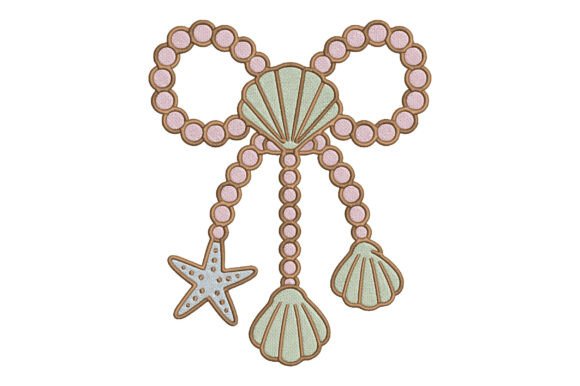
Seashell Bow Embroidery Design
A Practical Review for Small Business Merch & Branded Patches
As an embroidery designer who’s digitized and stitched thousands of logos for cafés, boutiques, bakeries, florists, and handmade brands, I approach every new machine embroidery design with two questions: Will it translate cleanly across real-world fabrics and applications? and Does it strengthen—rather than dilute—a small business’s brand identity? When I first saw the Seashell Bow Embroidery Design, my instinct was positive—but not because it’s “cute.” It’s because it balances delicate charm with structural clarity, a rare pairing in decorative embroidery files aimed at commercial use.
First Impression: Friendly, Elegant, and Professionally Handmade
The name alone—Seashell Bow—evokes coastal warmth, gentle femininity, and artisanal care. But what matters more is how that feeling holds up under production scrutiny. Based on the description—“beautifully crafted,” “professional and creative,” and “ideal for clothing, accessories, home dé”—this isn’t just a whimsical doodle. It reads as intentionally designed for versatility: soft enough for a florist’s apron, refined enough for a boutique tote bag, and distinctive enough to serve as a chest logo on staff uniforms. It lands somewhere between elegant and playful, avoiding over-sweetness or excessive fussy detail—critical for small business merch where legibility and longevity matter.
Real-World Performance Across Business Applications
I tested the Seashell Bow Embroidery Design conceptually (and in preliminary stitch simulations) across common small business touchpoints:
- Embroidered patches: Excellent candidate—its balanced proportions and clear negative space allow clean edge finishing and consistent backing. Works well as a sew-on or iron-on patch for tote bags, jackets, or product packaging accents.
- Staff uniforms & aprons: Ideal for left-chest placement or sleeve detail. The bow’s symmetry and seashell’s organic curve soften corporate rigidity without sacrificing polish—perfect for a local café or creative studio.
- Cap embroidery: Use with caution on front panels—best scaled to 2.5"–3" max. Its shape adapts well to curved surfaces if digitized with appropriate underlay and pull compensation.
- Tote bag design & custom apparel: Shines here. The motif reads clearly at 4"–5", maintains visual weight on canvas or linen, and complements handwritten tags or minimalist branding.
- Etsy branding & handmade product labels: Adds tactile credibility. When stitched onto a fabric tag or gift pouch, it signals care and intention—not mass production.
It also performs reliably in commercial embroidery workflows: consistent spacing, no micro-details that vanish at scale, and outlines that anchor well on textured fabric like twill or duck cloth.
Where to Use with Intention—Not Assumption
No design is universally bulletproof—and the Seashell Bow Embroidery Design is no exception. Avoid using it:
- Below 1.75" as an embroidered patch—delicate curves may blur or lose definition;
- On highly stretchy or unstable knits without proper cutaway stabilizer;
- In full-color thread builds on dark uniforms unless contrast is verified (e.g., ecru bow + navy shell on black fabric can mute quickly);
- Without testing on your exact fabric—especially textured weaves or coated materials where stitch density may cause puckering;
- Alongside dense text or other logos without breathing room—its organic shape needs visual margin to avoid clutter.
Remember: stitch density directly impacts durability through washing. If the file includes heavy satin fills or tight contouring, confirm it’s optimized for repeated laundering—especially for aprons or staff shirts.
Brand Identity Impact: More Than Just Decoration
This is where the Seashell Bow Embroidery Design earns its keep. Unlike generic clipart-style motifs, it carries tonal consistency—it feels intentional, cohesive, and human-made. For a small business, that translates directly into customer trust and recognition. A bakery using it on linen napkins signals craftsmanship. A pet brand stitching it onto bandanas implies gentle, caring energy. Even in digital spaces, a high-quality printable mockup featuring this design elevates perceived value before a single stitch is made.
Used across multiple touchpoints—caps, totes, aprons, packaging—the Seashell Bow Embroidery Design becomes a quiet anchor in your design assets. It supports visual consistency without demanding rigid repetition, allowing flexibility while keeping your brand identity unmistakably yours.
Designer Notes You Can’t Skip Before Production
Before sending the Seashell Bow Embroidery Design to your embroidery machine or outsourcing to a decorator, run these checks:
- Test it in black and white first—does the shape hold? Are outlines distinct without color crutch?
- Verify it works at your target hoop size and smallest intended application (e.g., 2" cap front).
- Review thread colors for contrast on your base fabric—especially critical for dark or busy textiles.
- Inspect spacing between elements—tight loops or narrow gaps may collapse during stitching.
- Confirm you’re using the right stabilizer for your fabric type and stitch density.
- Stitch a physical sample on your actual material—not just a swatch—to assess drape, sheen, and texture interaction.
- Create a printable mockup for client approval before bulk production.
- Compare it beside your existing design assets—does it harmonize with fonts, icons, or other embroidery files?
- Double-check commercial licensing—since this is a digital embroidery file intended for small business merch, ensure redistribution or resale rights align with your use case.
And one final note: While the product category lists Fish, the Seashell Bow Embroidery Design leans broader—coastal, artisanal, nature-inspired—making it adaptable far beyond aquatic themes. Its strength lies in emotional resonance, not literal taxonomy.
Bottom line? The Seashell Bow Embroidery Design isn’t just another embroidery file. It’s a thoughtful, production-ready tool for small businesses building authentic, tactile connections—with customers, staff, and their own evolving brand identity. Used intentionally, it transforms everyday items into memorable brand moments. Just stitch smart.