Watering Flowers Embroidery
A Cheerful, Garden-Fresh Design That Sells at Craft Fairs
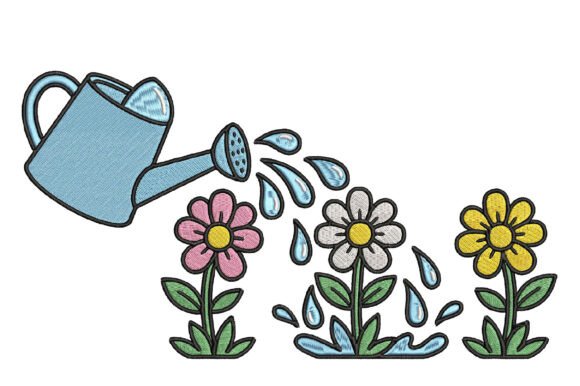
As an embroidery designer who’s packed, stitched, and sold at over 40 craft fairs and handmade markets, I’ll tell you straight: Watering Flowers Embroidery lands with immediate charm. It reads as cheerful, soft, and gently rustic—not overly detailed or stiff, but full of quiet movement and warmth. That watering can pouring onto blooming flowers? It’s a moment of care, growth, and everyday joy—exactly the kind of sentiment that draws customers to handmade product tables and makes them pause mid-aisle.
Where Watering Flowers Embroidery Shines on Real Products
This design isn’t just pretty—it’s practical. On a natural canvas tote bag, it reads clearly from six feet away. On a linen apron, it feels intentional and artisanal—not like filler, but like a signature touch. For tea towel embroidery, its balanced composition (watering can + flowers) fits neatly in the lower corner or centered above the hem, avoiding seam interference while still feeling generous and finished.
- Tote bag design: Works beautifully as a medium-scale focal point—large enough to read, small enough to leave room for branding or hand-stitched labels.
- Apron embroidery: Ideal for chest placement—soft curves echo the shape of the waistband and add visual rhythm without competing with pockets or straps.
- Embroidered patch: Highly adaptable. Trimmed and ironed-on, it adds instant garden personality to denim jackets, market bags, or kids’ backpacks.
- Pillow cover & small pouch: Translates well at 3–4 inches wide—retains clarity and avoids overcrowding the surface.
- Caps & curved surfaces: Use with caution—test first. The watering can’s handle and spout may distort slightly on high-crown caps unless digitized with gentle pull compensation.
What Makes This Design a Smart Choice for Etsy Sellers and Small Shop Owners
Watering Flowers Embroidery is inherently search-friendly and emotionally resonant. Think about how your ideal customer types into Etsy: “garden embroidery,” “spring tote bag,” “botanical apron,” “handmade flower patch.” This design lives comfortably in all those categories—and it’s not so literal or niche that it limits cross-selling. As a Single Flowers category piece, it’s versatile enough to pair with other botanical designs (think herb bundles or daisy chains), yet distinct enough to stand alone.
It photographs exceptionally well for online listings—especially on light linen, oatmeal canvas, or sage-green cotton. No harsh shadows, no confusing negative space. Just clean lines, soft contrast, and a clear story. That means less editing time for your printable mockup workflow and faster upload cycles for new digital embroidery file listings.
Production Notes Every Embroidery Business Owner Should Know
This isn’t a “stitch-and-go” design—but it’s not finicky either. Here’s what I check before committing to batch production:
- Stitch density: Moderate. Not heavy enough to buckle lightweight fabrics, but dense enough to hold detail on textured tea towels. Still, avoid ultra-thick terry cloth unless you double-stabilize.
- Fabric texture matters: On burlap or heavily slubbed linen, tiny water droplets or petal edges may blur. Test on your exact fabric—not just scrap cotton.
- Thread colors: Designed to shine in soft pastels (mint, buttercup, lavender) but also holds up in earthy tones (terracotta, olive, charcoal). Avoid low-contrast combos on dark fabric—those fine stems and spout lines need breathing room.
- Hoop size & spacing: Fits comfortably in a 4x4 hoop, but scales cleanly to 5x7 for larger tote placements. Confirm spacing between watering can and flowers doesn’t collapse when resized below 2.5 inches.
Design Assets That Support Your Booth—and Your Brand
Your craft fair booth tells a story before you say a word. Watering Flowers Embroidery strengthens that narrative: it signals care, seasonality, and handmade authenticity. When paired with real pressed flowers in your display jar or kraft tags stamped with “Grown With Love,” it builds cohesion—not just decoration. Customers don’t buy embroidery; they buy the feeling behind it. And this design delivers calm, growth, and gentle optimism—moods that convert fast in spring and early summer markets.
For boutique makers and creative entrepreneurs, it also supports brand consistency. Whether you’re launching a line of garden-themed kitchen goods or building a cohesive collection of handmade product bundles (tea towel + pouch + embroidered seed packet), Watering Flowers Embroidery serves as a unifying visual thread—literally and figuratively.
Before You Stitch: Five Must-Do Designer Checks
- Test the machine embroidery design on your actual fabric—not just stabilizer swatches. Linen behaves differently than quilting cotton; canvas reacts differently than chambray.
- Verify thread contrast by stitching a 2-inch version on your darkest and lightest base fabrics. Tiny details vanish fast on low-contrast pairings.
- Review spacing and underlay—especially around the watering can’s spout and the flower centers. Gaps or floating stitches break the illusion of flow.
- Confirm your hoop size and stabilizer type match the design’s recommended setup. Lightweight tear-away works for totes; cut-away is safer for stretchy or textured tea towels.
- Create at least one real mockup—not just a digital preview. Drape that embroidered tea towel over a wooden bowl. Pin the patch to a denim vest. See how light hits the stitches in person. That’s where selling magic happens.
Final Thought: A Design That Grows With Your Business
Watering Flowers Embroidery is more than a charming motif—it’s a commercially flexible, emotionally grounded, and production-smart embroidery file. It works for the solo Etsy seller stitching evenings after work, the commercial embroidery studio scaling for wholesale orders, and the pop-up boutique owner curating seasonal craft fair product assortments. It invites repeat use—not because it’s generic, but because it’s quietly timeless. In a market flooded with loud trends and fleeting aesthetics, this design waters something deeper: connection, craft, and the simple joy of watching something bloom.