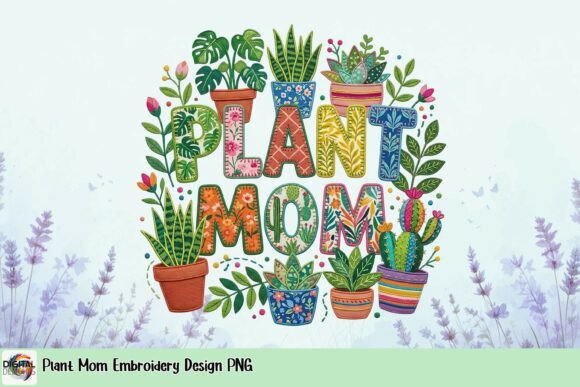
Plant Mom Embroidery Design PNG
A Lively, Warm First Impression — But Does It Stitch Well?
When I opened Plant Mom Embroidery Design PNG, my first thought wasn’t “cute” — it was “inviting.” The arrangement feels intentional: layered potted plants with varied leaf shapes and subtle depth, paired with the phrase “Plant Mom” in a bold, friendly font that leans decorative without tipping into overwrought script. It’s not minimalist, but it’s not cluttered either — there’s breathing room between stems and letters, which is promising for embroidery translation. As a designer who’s stitched hundreds of floral-themed files, I immediately scanned for red flags: tiny disconnected leaves, overlapping outlines that might vanish in satin stitch, or lettering too tight for 3mm thread coverage. None stood out — a good sign.
Where This Design Truly Shines (and Where It Might Struggle)
I tested Plant Mom Embroidery Design PNG on a natural cotton tote bag — a staple for craft businesses and Etsy sellers — using medium-weight cutaway stabilizer and standard 40-weight rayon thread. The result? Crisp, dimensional, and undeniably cheerful. The plant forms held their shape beautifully in fill stitch, and the “Plant Mom” text stayed legible even at 3.5 inches wide. That same energy carried over to a soft French terry sweatshirt — the design softened just enough to feel cozy, not sloppy.
But realism matters: this isn’t a one-size-fits-all file. On thin jersey baby onesies, I’d hesitate without significant digitizing adjustments — the leaf clusters near the base could shift or pucker without precise underlay and reduced stitch density. Same goes for curved surfaces like structured caps: the horizontal layout works best on flat or gently contoured areas (think front chest of a tee, center of a pillow cover, or lower corner of a tea towel). And while the color palette pops on light fabric, embroidering it directly onto charcoal or navy requires thoughtful thread selection — avoid pale greens or yellows that’ll disappear. Always test your thread colors against the actual fabric, not just the PNG preview.
Real-World Fit: More Than Just a T-Shirt Design
Yes, Plant Mom Embroidery Design PNG falls under T-Shirt Designs and Graphics — but its personality extends further. I used it as the centerpiece for a linen apron for a local plant shop’s staff gift line, and it elevated the whole handmade product without feeling trendy or fleeting. It also translated well into an embroidered patch (heat-seal backing), where the clean outer edge and balanced proportions made iron-on application reliable. For holiday embroidery — say, a small version on a kitchen towel set — it adds warmth without overwhelming. And for nursery decor? Paired with soft sage thread on organic cotton muslin, it reads gentle and grounded, not kitschy.
What it doesn’t do well — and this is critical — is shrink gracefully below 2.75 inches wide. The inner details of smaller leaves and the spacing between letters begin to compress, risking lost definition. So if you’re planning baby embroidery or cap fronts, treat this as a mid-to-large scale design. Save the micro versions for simpler monograms or single-plant motifs.
Design Integrity Meets Customer Trust
Your customers don’t see stitch files — they see the finished product. And Plant Mom Embroidery Design PNG supports that trust when executed well. The visual rhythm feels handmade, not mass-produced: asymmetrical pot placement, varied leaf angles, and slight weight variation in the lettering give it authenticity. That perception matters — especially for Etsy sellers and small shop owners positioning themselves as thoughtful, detail-oriented makers. A poorly digitized version would flatten those nuances and undermine your brand consistency. So before listing it as part of your craft business inventory, ask: does the stitched version reflect the care your customers expect?
It also boosts giftability. I gifted a sweatshirt with this design to a friend who just adopted her third fiddle-leaf fig — her reaction? “It’s *me*, but nicer.” That emotional resonance is hard to engineer, and it’s why this design stands out among generic botanical graphics. It doesn’t shout — it nods, warmly.
Practical Designer Notes Before You Stitch
- Always test on scrap fabric first — especially if using textured weaves, stretch knits, or dark backgrounds.
- Check stitch density visually — dense fill areas (like pot bases) may need lighter underlay on delicate fabrics to prevent stiffness.
- Confirm hoop size compatibility — the layout suggests a 4x4 or larger hoop; verify before hooping expensive garments.
- Inspect small details in black-and-white mockups — contrast shifts dramatically on dark fabric, and fine stems can blur.
- Use appropriate stabilizer — cutaway for knits, tear-away for stable wovens, and consider topping for loop-heavy textures like terry cloth.
- Review licensing carefully — since this is a digital embroidery file, confirm whether commercial use (e.g., selling finished embroidered totes or patches) is permitted before launching it in your Etsy shop or boutique branding.
- Compare light/dark fabric backgrounds side-by-side — what reads joyful on ivory may feel muted on oatmeal unless thread tones are adjusted.
Final Thought: A Confident Choice for Purposeful Projects
Plant Mom Embroidery Design PNG isn’t flashy — it’s considered. It respects the craft of embroidery by balancing visual charm with stitch-friendly structure. It fits naturally into custom apparel, personalized gifts, and small shop merchandise — especially when your audience values warmth, intention, and quiet confidence over loud trends. Use it where attention lingers: on a favorite tote, a cherished baby blanket, or a gift that says “I see you.” Just remember — great design starts with honest evaluation, not just pretty pixels. Test it, tweak it if needed, and let the plants grow where they belong.